LakesGeneral

Author name: Tina

Water Damage Restoration service
Blog, Licensed General Contractor

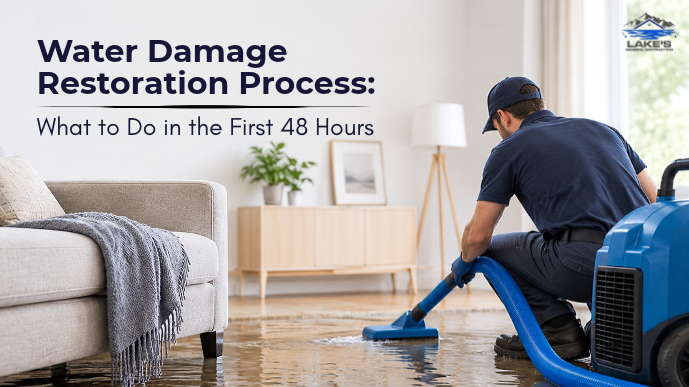
Water Damage Restoration Process: What to Do in the First 48 Hours

The first 48 hours after water damage can determine how extensive the repairs become. For residential water damage restoration in La Center, start by stopping the water source, cutting power to affected areas if it’s safe to do so, photographing all damage for your insurer, and beginning the drying process as quickly as possible. The EPA advises drying water-damaged materials within 24 to 48 hours to help prevent mold growth. Beyond that window, contamination risks can increase, and drywall, insulation, and subfloors may be more likely to require removal and replacement. Water in your home right now? Call Lake’s General Contracting at (360) 901-0292 for 24/7 emergency response in La Center, Ridgefield, Battle Ground, Woodland, and across Clark and Cowlitz Counties. It’s hard to think clearly with water on the floor. This guide walks through the water damage restoration process in order, from the first few minutes to the final coat of paint, plus what it typically costs and how Washington insurance usually handles it. KEY TAKEAWAYS The First 48 Hours at a Glance When What to do Why it matters First 15 minutes Shut off the water. Cut power to wet areas if you can reach the panel from a dry spot. Stops the damage from spreading and removes the shock risk First hour Photograph and video every wet room, the leak source, and damaged belongings. Your insurer needs to see conditions before cleanup Same day Call your insurer and a restoration contractor. Move belongings. Remove clean water if it’s safe. Insurers expect prompt reporting 24–48 hours Professional drying underway, with daily moisture readings. The EPA’s window for preventing mold After 48 hours Expect more tear-out and a mold check. Water degrades, and materials stop being salvageable. Why the First 48 Hours Matter Water keeps moving after you see it, and every hour it sits makes the job bigger. Mold can start within a day or two. The U.S. Environmental Protection Agency advises drying water-damaged areas and items within 24 to 48 hours to prevent mold growth. That’s the real deadline, and in a damp Southwest Washington fall or winter, wet materials won’t dry much on their own in that time. Clean water doesn’t stay clean. The restoration industry’s standard, IICRC S500, sorts water into three categories by how contaminated it is: Category Typical sources What it means for cleanup 1 — Clean water Broken supply line, overflowing sink or tub Materials can often be dried in place if you act fast 2 — Gray water Washing machine or dishwasher overflow Porous materials may need removal; surfaces are disinfected 3 — Black water Sewage backup, floodwater from outside Every porous material it touches comes out; professionals only Category 1 water doesn’t stay that way. Time, warmth, and contact with dirty building materials degrade it, often within a day or two, and that usually changes what can be dried and what has to be thrown out. Restorers also rate damage by class, from Class 1 (a small area with little absorption) to Class 4 (deep saturation of hardwood, plaster, or masonry). Category tells you how dirty the water is. Class tells you how much drying it will take. Both drive the cost. Hidden water damage behind walls and under floors The water you can see is rarely the whole problem. Drywall acts like a sponge, pulling moisture up the wall well above the puddle line. Water runs along joists and collects under laminate, vinyl plank, and hardwood, so a floor can look dry on top while the subfloor stays soaked for days. In homes with a crawl space, which is common across Clark County, water that gets through the subfloor can pool on the vapor barrier below, completely out of sight. What to Do After Water Damage: Step by Step 1. Stop the water and make the area safe. Close the main water shutoff, usually where the line enters the house, or the valve behind the leaking toilet or appliance. If water is near outlets, cords, or the electrical panel, don’t walk through it. Turn off power to the affected area at the breaker only if you can reach the panel from a dry spot. Otherwise, call your utility or an electrician first. Don’t switch on ceiling lights or fans under a wet or sagging ceiling, because sagging means water is pooling above it. 2. Document the damage before you clean up Before you move anything, photograph and video every wet room, the leak source, and damaged belongings, including inside closets and cabinets. Note the time you found the water. If something has to go to the curb, photograph it first and keep a small sample, such as a cut piece of carpet or drywall, until your adjuster has seen it. Call your insurer the same day. Washington’s Office of the Insurance Commissioner says homeowner policies usually cover sudden, accidental leaks if you report them quickly and follow your insurer’s recommendations. It also says extra damage caused by delaying repairs isn’t covered. 3. Remove clean standing water and move belongings If the water is clean and it’s safe, use towels, mops, or a wet-dry vacuum (never a household vacuum) to pick up what you can. Move rugs, furniture, and electronics to a dry room, and run fans and a dehumidifier if you have them. Skip this step with sewage or floodwater. Category 3 water carries bacteria, so leave cleanup to professionals with protective gear. 4. Call a contractor who can dry and rebuild Household fans can’t dry a wall cavity or a subfloor in time. A professional water damage repair team brings commercial air movers, dehumidifiers, and moisture meters that find water you can’t see, and monitors the drying until materials are back to normal. The Professional Water Damage Restoration Process Inspection and moisture mapping A technician confirms the water category and class, then maps how far moisture spread through walls, floors, and ceilings using moisture meters and, where needed, thermal imaging. Water extraction and structural drying Pumps and


Deck Repair vs. Replacement: How to Know What Your Deck Needs
Licensed General Contractor

Deck Repair vs. Replacement: How to Know What Your Deck Needs

QUICK ANSWERMost decks need repair, not replacement. Swapping a few soft boards, tightening a loose railing, or replacing rusted hardware usually fixes the problem for far less than a new deck. Replacement makes sense when rot reaches the joists, posts, or ledger board, or when damage is spread across most of the deck. Early fall is the time to check, before winter rain soaks any damaged wood. Your deck takes more abuse in Clark County than almost anywhere else on your house. Months of rain, moss, and shade wear on wood in ways a dry climate never would. This guide covers the seven warning signs to look for, what repair costs are compared with replacement, and how to decide which one your deck needs. KEY TAKEAWAYS Deck Repair, Restoration or Replacement: Which Do You Need? Option What it covers Choose it when Typical cost (Angi 2026) Repair Specific parts: boards, railings, stairs, hardware The frame is solid, and the damage is limited to a few spots About $2,246 average Restoration Deep clean, sanding, stain and sealer, plus small fixes The deck is sound but gray, rough, or covered in moss 550–1,250 to stain; 200–450 to pressure wash Replacement A new deck, or a new frame and surface Rot in joists, posts, or ledger; the deck sways; most boards are failing About $8,000 average What deck repair covers Repair fixes specific damaged parts: a few rotted boards, a loose railing, a wobbly step, or rusted connectors. The rest of the structure stays in place. What deck restoration includes Restoration brings back a deck that is structurally sound but tired. It usually means a deep clean, sanding rough or gray boards, then a fresh coat of stain and sealer, with small repairs handled along the way. Lake’s General Contracting’s deck repair and restoration service starts with an inspection of the structure before any cosmetic work, so you’re not sealing over a problem. When full replacement makes more sense Replacement is the better choice when the frame itself has failed: rotted joists, posts, or ledger board, a deck that sways, or one that doesn’t meet current safety codes. If you’d be replacing more than about half the boards anyway, a new deck often costs less over its lifetime. 7 Signs Your Deck Needs Repair 1. Soft or rotting deck boards Push a flathead screwdriver into any suspect spot. If the tip sinks in easily, or the wood feels spongy and breaks off in short pieces instead of long splinters, you’re likely looking at rot. Check most carefully where boards stay shaded or wet, like near planters and under downspouts. 2. Loose or wobbly railings Grab each railing and post and shake it firmly. It should feel solid. A railing that moves is a fall risk, especially on a raised deck, so fix it before your next gathering, not after. 3. Rusted fasteners and joist hangers Look under the deck at the metal brackets (joist hangers) and screws that hold the frame together. Heavy rust, flaking, or broken hardware weakens every connection it touches. Older decks were often built with hardware that wasn’t made for today’s treated lumber, which is more corrosive to standard steel. 4. Posts and footings showing rot or movement Check where posts meet the ground or the concrete footing. That’s where water collects. Soft wood, cracks, or posts that lean, sink, or shift mean the deck’s foundation needs attention. 5. Moss, mildew, and algae Green or black growth makes boards slippery and holds moisture against the wood, which speeds up rot. Professional power washing at the right pressure removes it without gouging the soft surface fibers the way a heavy-handed rental machine can. 6. Splintered and cracked boards Splinters and long cracks show the wood has dried out and lost its protective finish. Cracks let water deep into the board, where it freezes and expands in winter. Small surface checks can be sanded and sealed. Deep splits usually mean replacing the board. 7. Deck pulling away from the house This is the sign to take most seriously. The ledger board bolts the deck to your house, and the North American Deck and Railing Association estimates about 90% of deck collapses result from ledger connection failures. Most of those trace back to ledgers fastened with nails only, instead of bolts or structural screws. Look for a widening gap where the deck meets the house, nails with no bolts, missing flashing above the ledger, or water stains on the siding below. If you see any of these, stay off the deck until it’s been checked.  How Pacific Northwest Weather Affects Your Deck Moisture, rot and moss Wood rots when it stays damp, and in our climate decks can stay damp for months. Shaded decks under fir trees get it worst, since moss and needles trap water against the boards. Covering part of the deck is one of the most effective ways to cut that exposure, and a deck cover also makes the space usable through the rainy season. Why early fall is the window to seal and repair Stain needs dry wood and steady warmth. Cabot’s product data sheets say not to apply its deck stains when the air or surface temperature is below 50°F or may drop below 50°F within 48 hours, or when rain is on the way, and to let freshly cleaned wood dry for 24 to 48 hours first. In Clark County, overnight lows usually slip below 50°F by mid-fall, so the staining window closes sooner than many homeowners expect. Structural repairs are less fussy. Board, railing, and stair fixes can be done on most dry days, even into winter. Fixing soft spots now stops winter rain from turning small problems into structural ones. Timing can help your budget too: Angi notes that contractors are busiest from late spring through early fall, so cosmetic work booked outside that window may cost less. Deck Repair Cost vs. Replacement Cost According to Angi’s 2026 data, the average deck repair

Handyman vs. General Contractor
Blog

Handyman vs. General Contractor: Who to Hire for Your Home Repair Project

Most homeowners treat this as an either/or choice, but many repair lists include both kinds of work. This guide explains where the line sits, what Washington requires of each, and when hiring one company that does both is the simplest option  What Does a Handyman Do? A handyman takes care of small repairs and odd jobs. The work usually takes hours, not weeks, involves one trade at a time, and doesn’t change how the house is built. Common handyman jobs Typical handyman services include: These jobs are usually quick and affordable. HomeAdvisor’s handyman pricing data puts most projects between $165 and $615, with an average of about $390. Lake’s General Contracting takes on this kind of work every week, from a single repair to a full list grouped into one visit. For ongoing upkeep, see our home maintenance and repair services  Limits of handyman work in Washington State Washington has no separate “handyman license.” Anyone paid to repair or improve a home must register as a contractor with the Washington State Department of Labor & Industries (L&I). A handyman is no exception. Registration doesn’t cover every trade. Electrical work requires an electrical contractor license, and plumbing requires a plumbing contractor registration and certified plumbers. So a handyman with only a basic registration can’t legally add a circuit, move a drain, or replace a water heater. Work that needs a building permit, like replacing windows or changing framing, usually goes beyond a handyman’s lane too. That’s the advantage of hiring a handyman who is also a registered general contractor: when a small job turns into permit-level work, it doesn’t have to change hands.  What Does a General Contractor Do? A general contractor (GC) runs the whole project. They may do some of the work themselves, but their main job is making sure everything gets done right, in the right order, and to code. Project management, permits, and subcontractors A GC prices the job, pulls permits, schedules inspections, and brings in the trades. An electrician, a plumber, a tile setter, and a drywall crew can all be on one project. Under Washington rules, a general contractor can hire subcontractors across specialties. A specialty contractor can only work in its registered specialty and cannot hire subcontractors, according to L&I’s registration rules. For you, a GC means one contract and one person to call. Remodels, additions, and structural work GCs handle the bigger work: a bathroom remodel or repair, a kitchen upgrade, additions, decks, patio construction, and rebuilding after water damage. If the job moves walls, changes framing, or reroutes plumbing, it belongs with a GC. Lake’s General Contracting handles this side of the work too, as a registered general contractor serving Clark and Cowlitz Counties.  Handyman vs. General Contractor: Side-by-Side Comparison Factor Handyman General contractor Typical jobs Small repairs, one trade at a time Remodels, structural and multi-trade work Permits Rarely needed for the work itself Pulls and manages permits and inspections Other trades Usually works alone Hires and coordinates licensed trades Washington registration Required (L&I) Required (L&I) Required bond $15,000 if registered as specialty, $30,000 if general $30,000 Typical pricing 60–125 per hour, or a flat rate Often 10%–20% of project cost Scope of work: the one-sentence test If the job needs a permit, more than one trade, or changes to the structure, call a general contractor. If it’s a fix you can describe in one sentence, “the bathroom door won’t latch,” a handyman is usually the right fit. Licensing, bonding and insurance Both must register with L&I. A registered general contractor carries a $30,000 bond and a specialty contractor a $15,000 bond. Those amounts took effect July 1, 2024, more than doubling the old levels of $12,000 and $6,000. Both also need general liability insurance of at least $200,000 in public liability and $50,000 in property damage, or $250,000 combined. That insurance is what responds if the contractor’s work damages your home. Cost and pricing structure Handymen often charge by the hour, about $60 to $125 plus materials, according to HomeAdvisor. General contractors commonly add 10% to 20% of the total project cost for overhead and management, on top of labor and materials. On a $20,000 bathroom remodel, a 15% fee is $3,000. That fee covers permits, scheduling, and keeping the trades on track. Paying it to patch one hole makes no sense. Skipping it on a remodel can cost more in failed inspections and redone work. Washington Contractor Rules Homeowners Should Know How to verify a contractor’s registration with L&I It takes about five minutes: 1.    Ask for the company’s exact business name and L&I registration number. 2.    Look it up with L&I’s free Verify tool at ProtectMyHome.net, or call 1-800-647-0982. 3.    Check that the registration is active and the bond and insurance are current. 4.    Check workers’ comp coverage and look for violations or lawsuits against the bond. 5.    For electrical or plumbing work, confirm the separate trade license too. Risks of hiring an unregistered contractor L&I is blunt about it: unregistered contractors carry no bond or insurance to protect consumers. If the job goes wrong, there’s no bond to file a claim against. Low bids are often the hook. L&I warns that unregistered contractors can underbid legitimate firms by misclassifying workers to dodge workers’ comp premiums and unemployment taxes. Those savings disappear fast if someone gets hurt on your property or the work has to be redone. Handyman and General Contractor in One: Lake’s General Contracting Real repair lists rarely fit one box. The drywall patch sits next to a leaking shower valve. The sticking door turns out to be a framing issue. Hiring two companies means two schedules, two bills, and two people pointing at each other. Lake’s General Contracting is both. We’re a registered general contractor in Washington, and we also take on everyday handyman jobs. The same team that fixes a sticking door or patches drywall also handles full remodels and repairs. If a small fix turns into a

Blog

Common Flooring Problems and How Professional Installation Services Solve Them

Are you facing issues with your flooring and wondering if professional installation services are the solution? You’re not alone. Many homeowners encounter common flooring problems that can compromise the aesthetics, functionality, and safety of their living spaces. In this blog, we’ll delve into these issues and explore how hiring professional flooring installation services can be the key to resolving them. 1. Uneven Surfaces and Subfloor Problems: One of the most common challenges homeowners face is uneven flooring surfaces. Whether it’s due to an improperly prepared subfloor or the natural settling of a house over time, uneven floors can lead to a range of issues, from squeaks and creaks to potential safety hazards. Professional flooring installation services begin by assessing the subfloor, addressing any irregularities, and ensuring a level foundation for the new flooring. This meticulous approach not only improves the overall aesthetics but also enhances the longevity of the flooring. 2. Incorrect Installation Techniques: DIY flooring projects, while tempting, often fall victim to incorrect installation techniques. Improperly aligned tiles, uneven planks, or poorly secured flooring can result in an unappealing finish and may even pose safety risks. Flooring installation services conducted by professionals with industry expertise ensure that the installation follows recommended practices. From accurate measurements to precise cuts and seamless joins, professionals deliver a polished result that stands the test of time. 3. Water Damage and Mold Issues: In areas prone to moisture, such as kitchens and bathrooms, water damage is a persistent threat. Improperly installed flooring can allow water to seep through, leading to damage, warping, and the development of mold. Professional installation services incorporate moisture-resistant materials and advanced sealing techniques to safeguard your floors against water-related issues. This proactive approach not only preserves the integrity of the flooring but also contributes to a healthier indoor environment. 4. Wear and Tear in High-Traffic Areas: Certain areas of your home, like hallways and living rooms, experience higher foot traffic than others. Over time, this can result in visible wear and tear on your flooring, diminishing its visual appeal. Professional installation services take into account the specific demands of each space, recommending and implementing durable flooring solutions that can withstand heavy use. This ensures a longer lifespan for your floors and reduces the frequency of repairs and replacements. 5. Inadequate Acclimatization of Flooring Materials: Some flooring materials need time to acclimate to the conditions of the installation environment. Failure to allow for proper acclimatization can lead to issues such as buckling, warping, or gaps in the flooring. Professional installation services follow manufacturer guidelines for acclimatization, allowing the flooring materials to adjust to temperature and humidity levels. This meticulous attention to detail minimizes the risk of future problems and ensures a flawless installation. Why Choose Lake’s General Contracting? Lake’s General Contracting is your trusted partner in flooring installation and house repair services. With years of experience, we pride ourselves on delivering top-notch craftsmanship and personalized solutions tailored to your specific needs. Transform your home with confidence—choose Lake’s General Contracting for quality, reliability, and excellence. Conclusion In the realm of house repair services, opting for professional flooring installation services proves to be a strategic choice. From addressing uneven surfaces to combating water damage and wear and tear, the expertise of professionals enhances the overall quality and longevity of your flooring. Don’t let common flooring problems compromise the beauty and functionality of your home—investing in professional installation services is the key to a lasting solution.

Blog

Carpentry Magic: Enhancing Your Outdoor Space with Custom Fencing

Your outdoor space is more than just a backyard; it’s an extension of your home’s personality. Custom fencing, expertly crafted through professional carpentry services, has the power to transform your outdoor area into a haven of both beauty and functionality. In this blog, we’ll explore the enchanting world of custom fencing, emphasizing the role of carpentry in elevating your outdoor space. The Art of Custom Fencing: Your fence is the first impression guests have of your property, making it a crucial element of your home’s exterior. Off-the-shelf options may serve a basic purpose, but the magic truly happens when you opt for custom fencing. Professional carpentry services near you can turn your vision into reality, tailoring the design, height, and materials to suit your unique preferences and needs. Whether it’s a classic picket fence, a modern horizontal slat design, or a decorative lattice pattern, the possibilities are as vast as your imagination. Functionality Meets Aesthetics: Beyond the decorative appeal, custom fencing offers a myriad of functional benefits. It provides privacy, defines boundaries, and enhances security. If you’re in a location with specific weather challenges, a well-designed fence can act as a windbreak or shield against excessive sun exposure. Professional carpentry services take these functional aspects into account during the design and installation process, ensuring that your custom fence not only looks stunning but also serves a practical purpose. DIY vs. Professional Fence Installation and Repair: While the allure of a DIY project is undeniable when it comes to custom fencing, professional carpentry services near you can make all the difference. DIY installations may save money initially, but they often lack the precision and durability that professionals bring to the table. Custom fencing requires a level of expertise in measurements, materials, and installation techniques that only seasoned carpenters possess. Moreover, when it comes to fence repair, professionals can identify and address issues promptly, preventing small problems from becoming costly repairs down the line. Carpentry Services Near Me: Finding the Right Partner: The success of your custom fencing project hinges on choosing the right carpentry services near you. Begin by researching local contractors with a strong reputation for craftsmanship and reliability. Reading reviews, checking portfolios, and seeking recommendations from friends and neighbors are effective ways to narrow down your options. A reputable carpentry service will not only execute your vision with precision but will also provide guidance on design, material selection, and maintenance, ensuring a long-lasting and visually appealing result. Carpentry Magic in Action: Realizing Your Outdoor Dream Space: Imagine a custom fence that seamlessly complements your home’s architecture, enhances your landscaping, and creates a private oasis for relaxation. Professional carpentry services bring this vision to life, paying attention to every detail, from the choice of wood or other materials to the finishing touches. With their expertise, your outdoor space becomes an expression of your style and a functional sanctuary for you and your family. Trust Lake’s General Contracting to transform your outdoor area Lake’s General Contracting is your trusted partner in carpentry services, specializing in custom fence installation and repair. With a commitment to excellence and a passion for transforming outdoor spaces, we bring your vision to life. Choose Lake’s General Contracting for carpentry magic that goes beyond boundaries. Conclusion: Carpentry magic is at the heart of transforming your outdoor space with custom fencing. Say goodbye to cookie-cutter designs and embrace the unique charm that a tailor-made fence can bring to your home. From enhancing aesthetics to providing practical benefits, custom fencing crafted by professional carpentry services near you elevates your outdoor living experience.

Blog

5 Budget-Friendly Remodeling Ideas for Your Bathroom

Whether you construct or buy a house, you do your best to turn it into the sweet home you usually dreamt of. From interior design to exterior look, you pay attention to everything that comes in or around your abode. A bathroom is a valuable part of your home. You use it to become fresh before going out for any purpose. Like other parts, you do every possible thing to make your bathroom look and usable as per your living standard. However, with time, it requires your attention. And you start looking for bathroom remodel and repair ideas. Here are some effective ideas you can work on without spending too much money: 1. Repair the damaged part After some time, your bathroom needs repair work that could relate to its walls, cabinets, ceiling, floor, etc. Have a close look at every nook and corner of your bathroom to find which part or parts require repair and maintenance. For example, you see your bathroom floor is broken or damaged. You can do it yourself or hire flooring installation services for your bathroom. While working on it, you should be very careful to get the best value for your investment. 2. Replace or install a new mirror to create a wow factor It is possible that your bathroom would have a mirror that you would have been using to get the reflection of yourself while being in the bathroom. The mirror design you selected at that time may be outdated now or may not be as per your current living standard and convenience. If it is with you, install a new round/rectangular mirror as per your preferred design choice. 3. Install art pieces like paintings and posters Installing an exclusive painting or art piece can be very expensive. You can visit flea markets or shops in your locality to buy a few paintings and posters with a theme of your choice. The theme could be natural, abstract, or conventional. However, you must avoid hanging paintings/posters with a religious theme in your bathroom. 4. Have stylish shelves or cabinets    Your bathroom is beyond the place most of you usually think of. It is the place where you store your soaps, body lotions, and allied beauty care or personal grooming products. You want to have easy access to them when you need it. Having a stylish cabinet with open or closed shelves can help you fulfil your expectations. Installing a new one can help you give a fresh look to it. 5. Place artificial grass inside your bathroom In general, plants and trees are a part of your garden. You bring them inside your home by having in-house plants to get fresh air daily. However, you cannot place them inside your bathroom until you have a big one. There is a way to get this desire fulfilled. You can install artificial grass on the floor or walls of your bathroom.    Final words When it comes to remodeling your bathroom, you will come across numerous ideas in your search. Those ideas could be expensive. Following the ideas mentioned above will be affordable and will not cost you a lot as you move ahead to give a fresh look to your bathroom.

Blog

5 Comprehensive How-to-do Ideas for Common House Repair Services

Homeownership, or the idea of it at least, can be one of life’s ultimate joys. But choosing to own rather than rent means entering a universe of responsibility and care that extends far beyond time enjoyed on a wooden terrace or a cozy evening by the fireplace. It demands a certain level of dedication to ensure that one’s private sanctuary remains protected and in good condition. For your health, it is an important part to have regular health check-ups. Likewise, for the upkeep of your home, it is essential to have House Repair Services. Proceeding to beware of your outside apparatuses, heating and cooling, plumbing, security, and electrical frameworks will assist with forestalling breakdowns, setting aside cash, and keeping your home putting its best self forward. The framework of a building is often determined by the foundation, which is why foundation repair is an essential step in the maintenance of the durability of structures. In the recent past, technology has indeed advanced, and this has caused new advancements and better ways of fixing the foundation and getting comprehensive House Repair Services. Here are some step-by-step guides to help you fix the problem with house repair services. The identification of problem areas of the house When planning for house repair, it’s important to assess the extent of damage or parts that require attention. It may comprise rectifying a leaking tap, mending a broken water pipe, or even roofing a house that has had its roof destroyed. Another useful exercise is to spend several hours walking around your home as a ‘repair inspector’, identifying which parts of the house require repair. The next thing that you can consider, especially when you do not want to be left out or perhaps you want to be guided on which areas you need to focus on, is the home inspection checklist. The determination of priority for repairing You must understand the severity of the issue that needs addressing and prioritize the work that needs of completed. Experts can handle certain repairs, such as fixing a leaking door or a roof, immediately to prevent further deterioration of the structure. If your kitchen countertops are worn out or faded, you can postpone addressing other repair and renovation needs until later. The Establishment of Your Budget The last element involved in the planning of a house repair process is setting the financial resources, or, more specifically, the budget. This is important in order not to be locked into a position where one is consuming more than can be afforded or has more repairs than is necessary. Because this would vary from firm to firm, determining your budget should take into account the price of the material, wages, and salaries for the contractors and subcontractors, permits, and inspection fees. The Fixing Columns Another aspect that, in most cases, is not given a second thought is the need to repair columns. Columns are a critical component of the construction process because of their role in providing a strong support system for the structure of your home. If you notice that your columns are scored, then the best thing you can do is to get an expert to take a look at them. With column repairs, this will attract some cost based on the degree of damage and the type of column involved. Monthly home repair services Home inspections and doing home improvement projects monthly will help you stick to your schedule and reduce the burden of being behind schedule. You should follow a comprehensive home maintenance checklist each month to help save time and money. Now we will discuss the important part of the foundation repair services for property. What are the important aspects of the Foundation Repair Service for Properties? Moreover, it is crucial to state that the essential services of a foundation repair service remain essential for the stability of a property. Several vital reasons underscore the essential nature of such services: Conclusion In conclusion, you should hire a professional to get experienced house repair services. Lake’s General Contracting will provide Water Damage Services, Flooring Installation, and House Repair Services. It is evident that planning for house repair is quite easy, but it should not be a squash. If you follow a proper planning strategy such as the one that has been mentioned above, it will be rather easy to have your home in the right condition.

Scroll to Top